Alex Symons, PhD
Author | Speaker | Media Researcher & Commentator
You may not know their names or faces, but in the last 10 years, there has been a significant rise in political YouTubers who now shape public beliefs and attitudes – all in its unregulated, algorithmic environment, speaking freely without impartiality or editorial oversight of any traditional kind.
Drawing on the work of Nick Couldry, I (ironically) recorded a YouTube video explaining the key principles of how these YouTubers disrupt the ideology of the mainstream media:
To fully understand these influencers' impact, it must be recognized that YouTube is a highly unregulated, "Wild West" space for political speech. Its political influencers are “partners” with the platform (not employees, so YouTube has limited responsibility for their words). Officially, they are required to follow its loosely-applied “community guidelines,” but these are determined and enforced at YouTube’s discretion (and there is no publicly-available transparency as to who makes any individual decision).

To find out who the most powerful influencers were, back in 2024 I collected data on the top British political influencer YouTube channels (selecting those I could find who were actively working to persuade viewers of a particular side, most typically, either the fringe left or right). In a comparable method to my study of 100 women comedians, The initial results of that study are as follows:

Despite the range of political views, these YouTubers all make their reputations for being opposed in varying ways to traditional news TV and newspapers. As I discussed on the Media Reworked YouTube channel, this means, on their channels, they consistently cast themselves as “outsiders” or “rebels” (spending time critiquing news reports and discussion shows which, to them, fall flat or miss the facts). In their world, the BBC, Sky News, or ITV are the embodiment of misrepresentation and mishandled establishment control.

For some, their reputations as YouTubers were ready-made by their reported “cancellation” from regular TV - often for breaking with the perceived “acceptable” spectrum of views. This happened when the BBC's former Generation Game host, Jim Davidson came to be regarded as politically incorrect. While consistent throughout his long career, Davidson's comments reported in the press, and his West Indian on-stage character “Chalky white," all fell out of favor with TV executives.
In another variation, historian David Starkey was well known for presenting educational series for the BBC. That was until he committed a faux pas regarding immigration on a little-seen podcast interview. That interview later found its way into the mainstream press, and following this, Starkey's work with the BBC was ended.
Yet this "cancellation" gave a boost to their YouTube careers. Both Davidson and Starkey gained massive appeal to their fans expressly for their ostracization. As their passionate comments by fans demonstrate (littering their videos), these YouTubers’ gain most value to their audience by being perceived to challenge Britain’s powerful, media institutions.
To watch their videos, this was clearly the case for the comedian hosts of Triggernometry, the conservative titan Sargon of Akkad, and Ash Sarkar of Novara Media – all of whom offer cutting commentaries on the wrongs of “mainstream” media reporting (on issues like foreign policy, domestic issues, immigration or other topics… either it’s not left enough, or not enough right).

However, very ironically, many of these political YouTubers were able to raise their visibility by appearing as interviewees and panelists on “legacy” TV channels, like the BBC’s Newsnight and Question Time, Sky News, or ITV’s Good Morning Britain – making themselves even more popular to their fans on YouTube. They generate synergy between their TV and YouTube work (their appearances on TV are posted as clips on their channels, as well as those of the TV programs, increasing awareness of both).
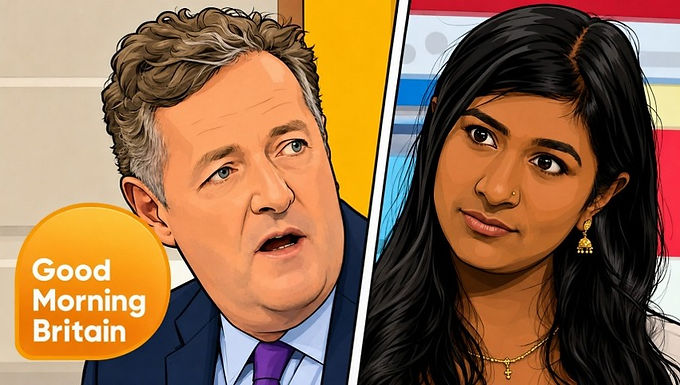
In addition, by daring to appear on legacy TV, YouTubers can enhance their reputations as “disruptors.” To their fans on YouTube, appearing in these shows means they can directly confront the perceived oppressive “hierarchy” of British media (think of Ash Sarkar sitting on Good Morning Britain, arguing passionately against the domineering then-presenter, Piers Morgan, or her loudly speaking up, addressing the audience from within the Question Time panel, surrounded by established journalists and governmental figures).
These opportunities to make their reputations can be understood in the work of sociologist Nick Couldry - he suggested that popular shows like Good Morning Britain present themselves as the “mediated center” of British life. This means they sell their social and political agendas as the “natural” and “common-held” opinions of the public. This is all kept under strict editorial control.
YouTubers invading TV news fracture that manufactured “mediated center” by arguing their "outsider views" as well as explicitly critiquing the channel and program itself. This happened on Newsnight when Ash Sarkar railed against the value of the British monarchy, which generated coverage in the Evening Standard.

Most significantly, YouTuber Sarkar gained immense fame when she snapped under pressure from Piers Morgan on Good Morning Britain, putting him in his place, calling him an “idiot.” That interview acquired an immense 7 million views when the clip was posted on her Novara Media channel. Then in the aftermath, Sarkar became a “mainstream” celebrity. She was interviewed by Teen Vogue and gained “traditional” work as a journalist – she wrote in 2018 for the Guardian, in 2021 for the New Statesman and Rolling Stone, and in 2022 for British GQ.
But there is a warning here for the future – TV news is breaking apart. More and more TV journalists and presenters are now beginning their own YouTube channels (Guardian-writer Owen Jones is a striking example). This means “mainstream” news is increasingly becoming a fractured space. It is becoming filled with people who are, to some extent, a “disruptor" - dedicated to promoting perceived unacceptable views.
Even while on TV, sitting in the comfy couches of Good Morning Britain or in the moody studio of Newsnight, creators like Jones and Sarkar remain YouTubers first. Whether left or right, they perform for their loyal fans online, where their TV interviews are later reposted (which is often a better source of income). Over time, this "disruption" undermines each program’s editorial views as well as its prestige.
If you'd like to read the original article on Disruptors, published in Celebrity Studies, you can find it here.