Mel Brooks: Creative Pioneer of Media Adaptations and Convergence
- Alex Symons

- 9 hours ago
- 4 min read
Updated: 22 minutes ago
Today, "creators" in the cultural industries are acclaimed for their business-savvy capitalization on convergence designed to generate synergy between their projects in different media industries. They are required to be masters of intuitively "reselling" content - producing an intermedial landscape which merges TV, film and theater. They do this to make the absolute most use of their intellectual property (IP), often derisively captured as "franchises" or "branding."
In all these industrial strategies, the now 100-year old Mel Brooks was ahead of his time.
While Brooks is rightly remembered for his contribution to Jewish comedy culture, his outrageous pushing of taste boundaries, and the Hollywood film parody genre, he was also an innovator of surviving in the cultural industries - recycling ideas and content across TV, film and theatre. Doing this, he capitalized on their layered meanings and appeal, all of which is understandable through the perspective and language of contemporary media scholarship; he was a pioneer of convergence, intermediality, and his own strategy of prolonged adaptation (endlessly rebooting content).
Blazing Saddles: an Intermedial Comedy
Superficially, Blazing Saddles superficially echoed a cycle of Western movies, drawing reference to classics as far back as The Great Train Robbery through its bearded, rustic old man of the town, speaking "authentic Western gibberish." Yet, it is not well recognized for its real sources - it was richly layered with contemporary US TV culture from its writing to its production values. This was clear in the presence of its scene-stealing, supporting actor, Harvey Korman ("give that man a hurrumph!"), was well known for his prime time performances on variety TV comedy, The Carol Burnett Show. There, he exhibited all the same audience-aware "campness" that he did in Blazing Saddles as "Hedley Lamarr." As Variety tellingly described the film, it was "essentially a protracted version of a television comedy skit." Indeed, it was written by a large group of writers including Richard Pryor, more like an episode of Saturday Night Live than a traditional screenplay.
TV was a hidden source even for Mel Brooks's acclaimed Young Frankenstein, written with its star Gene Wilder (after bitterly disputing the inclusion of a joke in the script together, they sadly parted creative ways). Again, superficially the film adhered to the special effects of James Whale's 1933 Frankenstein through the work of the same technician, Kenneth Strickfaden. But the casting of the British, onscreen talent Marty Feldman that made the film intermedial - Feldman was a TV performer first, known then for skits in The 1948 Show (the origin of the cult "Four Yorkshireman" skit), in which he performed with Pythons John Cleese, Graham Chapman, and Goodies member, Tim Brooke-Taylor. Feldman's bulging eyes did part of the work form him (a result of a real-life thyroid issue), but his highly surreal asides, echoing domestic experiences were more in-keeping with his TV-saturated viewership than the 1930s horror film mise-en-scene ("I remember, my old man would say to me, 'what are you doing in that bathroom all day and night? Other people have got to get in there too!")
This all may be because TV writing was the beginning of Brooks's career, where he first honed his skills writing for Your Show of Shows in the 1950s, collaboratively creating skits of Sid Caesar with other writers including Woody Allen. Caesar was an iconic star during the "golden age" of live US comedy programming. Brooks often returned to TV, including developing some short-lived TV projects, The Nutt House in the '80s (a hotel-based sitcom farce, starring Korman and Cloris Leachman of Young Frankenstein), When things Were Rotten (a Robin Hood parody) in the '70s, and never-broadcast pilot, a spinoff from Blazing Saddles titled Black Bart.
The Producers: Prolonged Adaptation
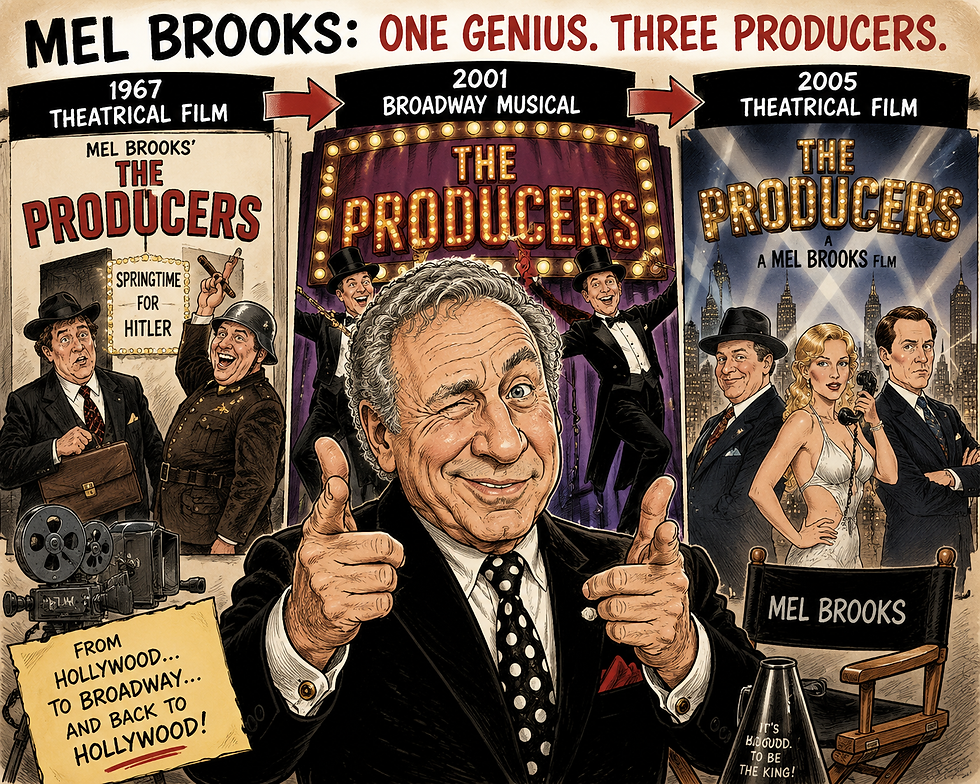
Brooks's project, The Producers is the premiere example of his "prolonged adaptation" strategy - reusing ideas, transmitting them through differing mediums. The Producers (1968) was his first original screenplay - a masterpiece which won him an Oscar. Yet at the time, it was panned by critics from the Village Voice and New York Times for the "hammy" performance by Zero Mostel, its seemingly cheap staging and uncinematic direction (alike a filmed theatrical set). The film was a brilliant reinvention of theatre, a film about Broadway echoing its production and acting style - especially in its Busby Berkley-esque Springtime for Hitler number, and Mostel's full Brechtian to-camera mugging. It was this very theatricality which turned off critics at the time, who were predisposed to favoring New Hollywood's cinematic "modernity." with films like The Graduate.
When Brooks adapted his film for Broadway, it was a record-breaking, worldwide success, becoming the first show to take one billion dollars. During it's run The Producers was reinvented through numerous increasingly curious casting choices - even including lovable, Italian-American star Tony Danza, known for sitcom Who's the Boss? playing producer Max Bialystock. It was on the back of this adaptation, Brooks then became the first single author to re-adapt his Broadway show back into a new film (with its original cast Nathan Lane and Mathew Broderick, but complemented by Hollywood comedy A-lister Will Ferrell as the deranged Nazi playwright Franz Liebkind, and Uma Thurman in the ironic role of Ula the Swedish secretary).
Even More Adaptations
In more recent years, Brooks has persisted with his adaptation strategy applied to a new generation of projects. This began with the critically and commercially successful Broadway adaptation of his film Young Frankenstein, this time starring Roger Bart, followed by the reboot of his film Spaceballs as an animated series for niche TV network G4. Only this year, Brooks has been revealed to be involved in the cinematic sequel to his film Spaceballs, subtitled (a la Friends) as "The New One."
Yes, Brooks's remaking of content "works" in the cultural industries, efficiently reviving presold content. Yet as scholars of adaptation, from Linda Hutcheon to Thomas Leitch have shown, these works become richer the more they are revived. They capitalize on audience familiarity and affection, as well as demanding his audience's apply a sophisticated ability to "read" films and television in an intertextual way, mixing recognition with what Hutcheon has called "the piquancy of surprise."
Read more:
Comments